
Digital Workplace: the strategic nerve center of modern organizations

Workplace
inventx-digital-workplace-strategisches-nervenzentrum-moderne-organisation
With the digital workplace, we conclude our “Composable Business” series. It is the place where the threads of all previously discussed aspects—from governance to platform—come together and translate into tangible impact. For banks and health insurers, the digital workplace is the key to efficiency, security, and future-proof collaboration.

For banks and health insurers, the digital workplace has evolved into a strategic nerve centre and an indispensable success factor in the day-to-day operations of the entire organisation. The reason lies in the sector-specific conditions: the environment of banks and health insurers is characterised by regulatory requirements, rising customer expectations and ever shorter innovation cycles. Not to mention the major challenges in IT security, because the digital workplace is the critical link in the security chain. 

Meeting these challenges successfully requires a modern digital workplace that not only delivers efficiency gains, but also offers the opportunity to realise new forms of collaboration and value creation. The evolution of the Digital Workplace from a platform for IT applications into an integrated, intelligent and highly personalised work tool that meets the highest requirements for security and compliance will continue over the coming years. This transformation demands strategic thinking, technological foresight and bold decisions from companies. 

Shaping the future: trends in the digital workplace

The shift towards an intelligent, secure and personalised digital workplace has long been under way, and it is being further accelerated by technological and cultural developments. The following trends show where the journey is heading and what requirements banks and health insurers will need to take into account in the future.

  • Artificial Intelligence 

    AI assistants such as Microsoft Copilot or embedded agents support employees individually, prioritise tasks, automate routines and provide context-based information in real time. 

  • Automation 

    Intelligent workflows and no-code applications increase efficiency even in areas that have previously been dominated by manual work. They adapt dynamically to user behaviour and business requirements. 

  • Zero Trust by Design

    Hybrid working is here to stay. Security architectures must be based on zero-trust principles—namely with continuous authentication, endpoint monitoring and context-sensitive access models. 

  • Edge Computing 

    Local data processing at the point of origin, combined with fast connectivity and powerful end devices, improves the performance of cloud-based applications and opens up new use cases. 

  • Immersive experiences 

    Although still in its infancy, augmented & virtual reality (mixed reality) will find its first practical applications in the workplace. Conceivable examples include virtual meeting rooms or training for new products. 

  • Employee Experience

    The workplace must meet individual needs: intuitive interfaces, collaborative tools and personalised learning offerings are the focus. Feedback and user data become the basis for continuous optimisation. 

  • Lifelong learning 

    The digital workplace becomes a learning platform. Micro-learning and integrated knowledge databases proactively support employees in developing new skills. 

  • Sustainability 

    Resource-saving technologies, efficient collaboration and transparent presentation of the digital footprint are gaining stronger focus. 

  • Digital wellbeing 

    A healthy balance between availability and recovery: focus times, workload management and clear communication rules promote digital wellbeing. 


The workforce structure is changing

In addition to the trends described above, the sociodemographic structure of the population will also change significantly. This shift will have a major impact on the workforce structure of every company. The traditional organisation with permanently employed staff, in defined organisational structures, at fixed workplaces and at defined locations is increasingly losing relevance. What tendencies can be observed in the market, and what influence does this have on the digital workplace?
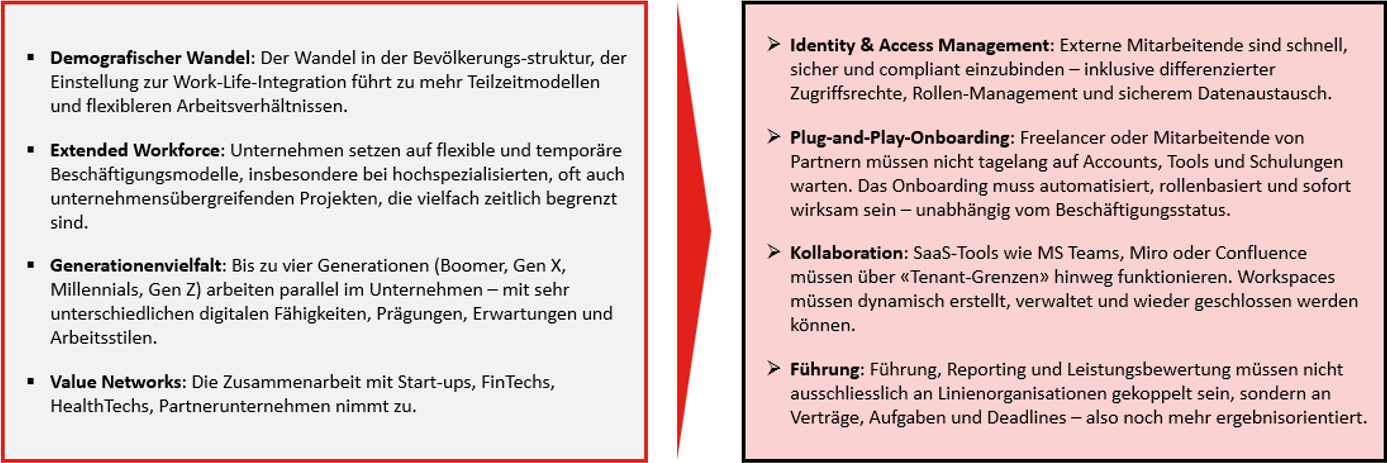
inventx-digital-workplace-einflussfaktoren

Excursus: Impact of AI on knowledge work

The use of Artificial Intelligence (AI) is fundamentally changing knowledge work and, with it, the requirements for the digital workplace. Where skilled professionals today spend many hours on research, analysis, and documentation, AI is increasingly taking on the role of an intelligent assistant that prepares information in context, automates processes, and supports decisions—and in the future will increasingly make them as well. 

In the digital workplace of the future, AI is seamlessly integrated into applications as an intelligent function within processes, not as a separate tool. Employees receive information exactly when it is needed: through smart search functions, automatic recommendations, and document analysis. Classic navigation through file repositories and databases is being replaced by dialogue-based interaction via voice or text input. 

AI also promotes collaborative intelligence: it identifies similar cases (e.g., customer requests), suggests suitable experts or solutions, and highlights risks—across teams and departments. For complex tasks, it acts as a coach, identifies learning needs, and presents relevant content. Knowledge work thus becomes more dynamic, relieving, and highly individualized. 

This development brings new compliance challenges. Banks and insurers must ensure that AI systems are explainable, ethically justifiable, and technically integrated cleanly. Handling sensitive data requires clear governance and robust control mechanisms. At the same time, employees must be empowered to use AI confidently—not only as users, but as co-creators of the new working reality. 

Last but not least, a social field of tension is emerging: the more routine and analytical tasks are taken over by AI, the more traditional knowledge-work roles come under pressure. Role profiles are changing; some activities disappear entirely. Efficiency increases, but the impact on the labor market and society is significant. 


Core functions of a modern digital workplace

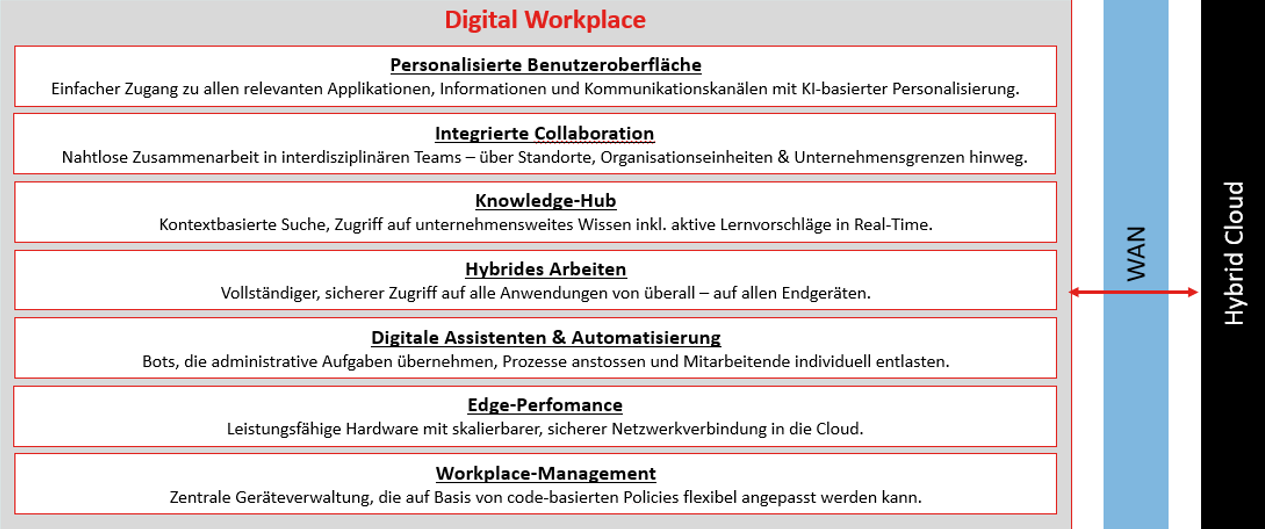
A future-oriented digital workplace must do far more than merely provide access to applications. It combines personalization, collaboration, knowledge, security, and performance into an integrated working environment. The following core functions should be provided by a future-oriented, modern digital workplace: 


inventx-digital-workplace-kernfunktionen

Conclusion: Rethinking the digital workplace as the key to the future 

The Digital Workplace of the future is being created today. Banks and health insurers face the task not only of setting the technological course, but also of helping shape a digitalisation strategy that fundamentally transforms the world of work. This is not just about software and IT architecture, but about collaboration, culture, processes, and social responsibility towards employees. The modern Digital Workplace enables hybrid, cross-border working and collaboration, with continuous, needs-based learning as an integral component. The traditional boundary between internal and external is becoming blurred—and that is precisely why concepts based on Zero Trust, new architectures, processes, and mindsets are needed. 

The digital workplace therefore must not only be redesigned technologically, but also conceived as an efficiency platform for the secure use (Zero Trust) of applications, protected access to corporate data, and as a “hub” for collaboration and knowledge management, as well as for the further development and upskilling of employees. 
 

Author

Urs Rhyner

Head of Business Development & Sales

LinkedIn
Foto Urs Rhyner

Contact