In the article on modernizing the data platform, we outlined the challenges of today’s data architecture and introduced new concepts such as Data Mesh and Data Lakehouse, as well as a target architecture based on the Azure platform. This follow-up article focuses on outlining how to move from the current state to the target vision. Our corresponding roadmap for transforming the data platform provides a high-level view of the individual phases and the associated parallel operation:
AI-Ready Data: a guide for the Swiss financial industry

The key to successfully using AI lies in optimizing and systematically leveraging data—the backbone of digitalization—especially for banks and insurers with their substantial volume of customers and transactions. In this sector, this is further intensified by trends such as rising customer expectations for personalized services and the pressure to comply with regulatory requirements. Business data must be high quality, integrated, securely managed, up to date, and easily accessible.
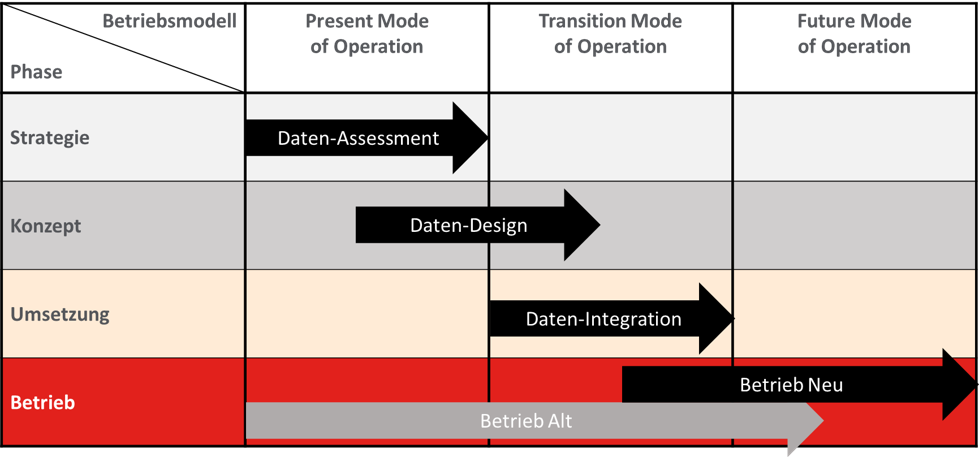
Let us now shed light on the content of the individual phases of our roadmap and their challenges:
Data Assessment
The first phase is based on a data-specific specification of the business strategy. The aim is to define how business data should be used in the future to generate competitive advantages. It is necessary to describe for what purpose and in which business processes which data should be used. We recommend creating and maintaining a use-case inventory (application, benefit, source system, input, ETL processes, output, target system, priority, etc.). This register is based, on the one hand, on the current (as well as any not yet realized) applications in the area of today’s business intelligence. On the other hand, it should list the new application scenarios in the field of artificial intelligence, including the corresponding data requirements.
Data Design
This phase consists of the following elements:
I) Analysis:
The current strengths of the existing data platform (e.g., availability, commodity technology, etc.) must be captured, and possible weaknesses (e.g., real-time capability, load times, etc.) must also be documented. This phase requires extremely close alignment with the business units, as the modernization of the data platform is of enormous strategic relevance for the business.
II) Design Principles:
Based on this analysis—and in alignment with the IT strategy and the requirements in the areas of IT security and compliance—the design principles for the target state are formulated. These principles serve as an “anchor” for the conceptual phase that follows.
III) High-Level Concept:
Based on the design principles and the evaluation, the solution architecture of the new data platform, its operating model, and data governance are to be defined.
IV) Proposal:
Now a business case and a high-level plan for the initiative must be prepared, which will serve as the basis for the proposal to executive management.
V) Detailed Concept:
If executive management approves the project, the elaboration of the technical and organizational detailed concepts begins, together with the detailing of the transformation roadmap.
Data Integration
Depending on the result of the evaluation and/or solution design, a PoC with the new solution may be desired. In the public cloud, platform services (e.g., Azure Fabric) are available that support this phase in an ideal way, as they are “deployable on demand.” In this phase, the solution should be set up and the data interfaces required for the application scenarios should be integrated. At least two environments (test and production) must be planned. In this integration phase, the detailed cutover plan is created, which also includes the phase-out of the old platform. The new data platform should then be put into productive operation with a first use case and formally accepted.
Operations
In the first phase of operations, we naturally have productive parallel operation of the old and new data platforms. This phase should be kept as short as possible, as the incurred costs and operational effort are considerable due to the high complexity. The switch-over of existing applications from the legacy platform defined in the migration plan must be implemented consistently. It goes without saying that new use cases should only be implemented on the new platform. During the phase-out of the legacy platform, it may be necessary to consider that certain data must be archived for regulatory reasons.
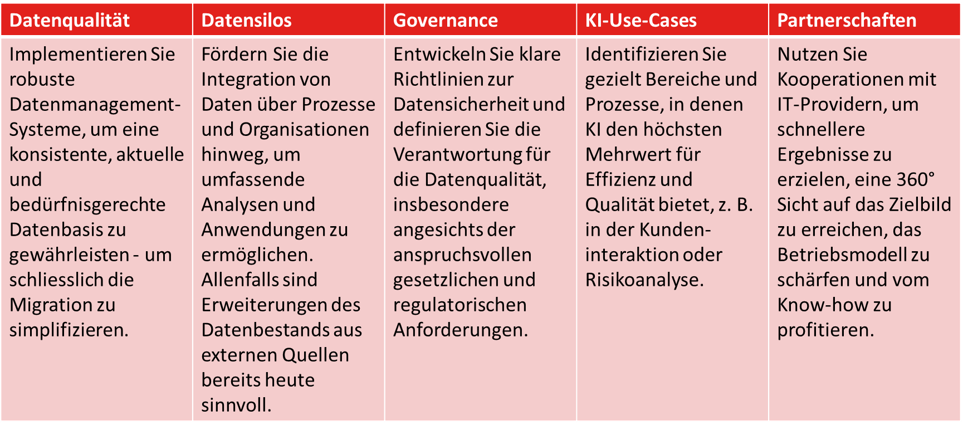
Based on this approach, the following recommendations for action emerge, which are already relevant in the current state:
Note: Together with academia, InventxLab has authored various studies on the use cases of AI in the financial industry. We are happy to provide these upon request and are personally available.
Conclusion
Creating a modern “AI-ready” data platform is a medium-term necessity for Swiss banks and insurers. The earlier such a platform is implemented, the greater the chance of strategic differentiation in the competitive landscape. Focusing on data quality, integrating data silos, enforcing strict governance, and modernising the technology base will not only facilitate AI adoption, but also strengthen the company’s long-term digital innovation capability as a whole.
Author

Discover more
More news and current topics at a glance.